For paramedic students, nurses and preceptors

Stop running out of ECGs to practice on.

Every tracing here is generated from a working model of the heart's electrical vector — so the axis, the reciprocal changes and the R-wave progression are all genuinely there, not drawn in by hand. Build any case you can describe, hand it to a student with the answer hidden, then reveal the reasoning line by line.

Opens on a normal sinus rhythm. No account, no download, works on a phone.

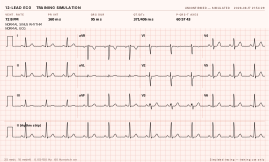
A simulated 12-lead ECG showing normal sinus rhythm, with the measurement block and interpretation across the top
An actual tracing from the simulator — normal sinus rhythm, 72 bpm.
85preset cases, from normal to pre-arrest
variations — findings stack on each other
0accounts, installs or cost to get started

What you can do with it

Build the case you're teaching

Pick a rhythm, then stack findings the way real patients present them — an inferior STEMI with a Wenckebach with muscle tremor artifact. Rate, ectopy, AV block, axis, bundle branch and fascicular block, pre-excitation, pacing, infarct territory and stage, chamber enlargement, electrolytes, overdose patterns, right-sided and posterior leads.

Test without giving it away

Blind mode hides the measurements, the machine interpretation, the case name and the whole control panel. The student gets a tracing and nothing else — the way it arrives on a real call. Share the link and it opens blind on their device too.

Show the why, not just the answer

Reveal walks the tracing in the order it should be read: rate, rhythm, axis, intervals, morphology, ST segments, then the anatomy — which wall, which artery, and what complication to expect next. It's the explanation a good preceptor gives over a coffee, attached to every case.

Measure it like paper

Drag the on-screen calipers across any lead for real time and voltage readings. The tracing is drawn at a true 25 mm/s and 10 mm/mV on real ECG paper, so a box is a box — and it prints that way for a written exam.
Sample cases

Three of the 85, rendered by the simulator right now. Every one of them is a live case in the app, not a screenshot of a textbook.

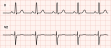
Leads II and V2 of a normal sinus rhythm
Normal sinus rhythm — the baseline every other case is judged against.
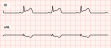
Lead III showing ST elevation with reciprocal depression in aVL
Inferior STEMI — elevation in III with the reciprocal depression in aVL falling out of the model on its own.
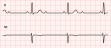
Leads II and V1 showing complete heart block with a junctional escape rhythm
Complete heart block — P waves marching through at their own rate, independent of the escape.

Open the simulator

How it works

  1. 1

    Open a case

    It starts on a normal sinus rhythm. Choose a preset from the library, or open the case builder and set the findings yourself.

  2. 2

    Turn on blind mode

    Everything that would give the answer away disappears. Hand over the tablet, or send the link — it opens blind for them as well.

  3. 3

    Reveal and talk it through

    The walkthrough gives the reasoning step by step, so the debrief is about the electricity rather than about who guessed right.

Why the tracings hold up

Most practice ECGs are drawings. Someone sketched an ST elevation into three leads and left the rest of the tracing alone — so a student who looks for the reciprocal change finds nothing, and quietly learns that it doesn't matter.

This one simulates the heart as an electrical vector in three dimensions and projects that vector onto all twelve leads. Move the axis and every lead responds. Infarct a wall and the leads facing it elevate while the leads opposite it depress, because that is what the geometry does.

The result is a tracing that rewards the habits you want students to build: comparing III to II, checking aVL before believing an inferior STEMI, walking the precordium for R-wave progression.

It also means the case library isn't a fixed set of pictures. Any combination of findings you can describe clinically, the model can render — including the ugly ones with artifact on top.

Ready to run a case?

Free to use, in the browser, starting on a normal sinus rhythm.

Open the simulator

Teaching a class or a whole program? Classroom features — assignable case sets, student progress, and a printable question bank — are in development. Tell us what you need.